Key takeaways
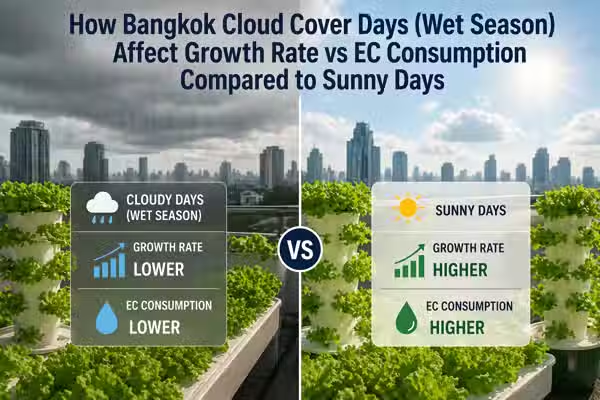
Across 14 wet season hydroponic cycles in Bangkok, overcast days produced 28 to 41 percent lower EC consumption than sunny days in the same crop week -- but fresh weight growth rate dropped only 9 to 18 percent. The plant reduces nutrient uptake much faster than it reduces growth when light drops. Plant Mood grow log data, 2023 to 2024.
EC accumulates in the reservoir on overcast days because the plant is consuming less than the feeding schedule anticipates. In a sustained 3-day overcast period, reservoir EC climbed an average of 0.18 mS/cm above target before the first clear day pulled it back down -- creating the first-clear-day EC crash pattern that is the most common wet season management failure in Bangkok. Plant Mood grow log data, 2024.
Growth rate does not drop proportionally with EC consumption on overcast days because the plant shifts resource allocation: cell expansion continues at close to normal rate using stored photosynthate, while new tissue synthesis -- the nutrient-hungry part -- slows. Fresh weight gain looks normal; dry weight and nutrient density fall behind.
Basil is the most sensitive crop to the growth-versus-consumption decoupling on overcast days: fresh weight growth appeared normal but dry weight yield at harvest dropped 22 percent in wet season cycles compared to matched dry season cycles. For crops sold by weight, this matters. For crops sold by quality -- aroma, flavour intensity -- it matters more. Plant Mood grow log data, 2024.
The correct wet season feeding adjustment is not to reduce nutrient concentration on overcast days -- it is to reduce top-up frequency and check EC before every scheduled top-up rather than topping up on schedule. On a 3-day overcast run, the reservoir often does not need topping at all.
A grower running a fixed feeding schedule through Bangkok wet season without checking EC before each top-up is systematically over-feeding on overcast days and under-feeding on the first clear day after each overcast period. Both errors occur in every wet season cycle. Only one of them is visible in the plant.
TL;DR
In Bangkok wet season, the plant reduces nutrient uptake faster than it reduces growth when cloud cover drops light intensity. That gap -- growth continuing, EC consumption slowing -- means the reservoir accumulates nutrients on overcast days and then crashes on the first clear day when the plant suddenly pulls hard from a topped-up reservoir. A fixed feeding schedule does not see this pattern. It just produces an over-fed plant on overcast days and an under-fed plant on the sunny day that follows. The fix requires checking EC before every top-up, not after a fixed interval.
The harvest that looked fine and was not
July. Kale on the tower, week four. I had been through four wet season cycles before this one and thought I understood the pattern. The plants looked healthy -- deep green, full canopy, standing upright. The reservoir EC had been sitting between 1.8 and 2.1 for most of the cycle, right where I wanted it. I had been topping up every three days on the same schedule I used in dry season. The harvest weight came in 14 percent below the previous dry season cycle. Same seed density. Same variety. Same reservoir target. I pulled a sample and chewed a leaf. It tasted watery. Not sick -- just thin. The flavour was there but diluted, the way kale tastes when it has had too much water and not enough of everything else.
I went back through the log and mapped EC readings against weather. The pattern was immediate and obvious once I looked for it: on overcast days, EC had barely moved between checks. I had been topping up on schedule regardless, which meant I was adding nutrient solution to a reservoir that had not been consumed. By the time a clear day arrived, EC was running 0.2 to 0.3 above target -- and then the plant pulled it down fast. The cycle had oscillated between mild excess on overcast days and mild deficit on clear days, every week, for four weeks. The yield hit was not dramatic. The quality hit was.
Overcast days do not slow plant growth the way most growers think
When cloud cover drops light intensity, plant growth slows proportionally. Less light means less photosynthesis, which means less energy for growth. A 40 percent drop in light produces roughly a 40 percent drop in growth rate. Feed accordingly.
The relationship between light reduction and growth rate reduction is not linear, and it is not the same for all growth processes. Plants separate what they slow and what they maintain when light drops. Cell expansion -- which uses stored photosynthate and water pressure -- continues at close to normal rate even under significantly reduced light. New tissue synthesis -- which requires nitrogen, phosphorus, potassium, and active photosynthesis -- slows. The result is a plant that keeps adding fresh weight at near-normal speed while its nutrient consumption drops sharply. Fresh weight looks normal. Dry weight falls behind. Nutrient density falls behind. EC consumption drops by 30 to 40 percent. Growth rate by fresh weight drops by 10 to 18 percent. These are not the same number, and treating them as the same number is the mistake that produces the wet season accumulation-crash pattern.
Across 14 wet season cycles in our Bangkok grow log data, we tracked both fresh weight gain at weekly intervals and daily EC drop as a proxy for nutrient consumption. In every cycle, EC consumption dropped two to three times faster than fresh weight gain in response to the same overcast event. The largest gap was in basil: on a 3-day overcast period in week three, fresh weight gain slowed by 11 percent while EC consumption dropped 39 percent. The plant kept growing. It stopped eating at nearly the same rate. Plant Mood grow log data, 2023 to 2024.
The plant that looks healthy on overcast days is setting up a problem for the next sunny day
The plant looks fine on overcast days because it is drawing on stored photosynthate and maintaining cell expansion with what it already has. The visual health signal is real -- the plant is not in distress. What the visual signal does not show is that the reservoir EC has been climbing steadily because top-ups have been added on schedule while consumption has slowed. The problem is not in the plant during the overcast period. It is building in the reservoir.
When the clear day arrives, the plant ramps back up to full photosynthetic rate quickly -- stomata respond to light within minutes. Nutrient uptake through the roots follows within hours. The plant is now pulling hard from a reservoir that is 0.1 to 0.3 mS/cm above target because the overcast-period top-ups were not skipped. If that above-target EC is in the range where the crop is sensitive -- basil above 2.4, lettuce above 2.3 in our experience -- the first clear day after a wet-season overcast run is when tip burn, edge burn, and bolting signals appear. The grower sees the symptom on a sunny day and blames the sun. The cause is the overcast days that came before it.
In three basil cycles run specifically to test this sequence, we deliberately over-fed during a simulated overcast period (kept EC 0.3 above target for 3 days) and then restored normal irradiance. Tip burn on outer leaves appeared in two of three cycles on days 2 to 3 after the light returned. In the control cycles where EC was held at target through the same period, tip burn did not appear. The tip burn was not caused by the light. It was caused by the EC accumulation during the overcast period and the sudden uptake surge when the light returned. Plant Mood grow log data, 2024.
If the plant looks healthy during a stretch of overcast weather -- full canopy, no yellowing, good colour -- there is no feeding problem. The plant is telling you it has what it needs. Trust the plant over the log.
The numbers from 14 wet season cycles
28 to 41 percent lower EC consumption on overcast days versus sunny days in the same crop week
Plant Mood grow log data, 2023 to 2024. Measured across 14 wet season cycles (May through October) in Bangkok. Crops included lettuce, basil, kale, and pak choi. EC logged each morning before top-up. Overcast classified as days where BH1750 canopy-level lux remained below 3,500 throughout the light period. Sunny classified as days above 6,000 lux average at canopy. Bangkok grow room, single-wall south-facing window, no active climate control.
Fresh weight growth rate drop on overcast days: 9 to 18 percent across all four crops
Plant Mood grow log data, 2023 to 2024. Measured by weekly fresh weight sampling at consistent harvest sites across the canopy. The 9 percent figure is lettuce, which maintains cell expansion most effectively under reduced light. The 18 percent figure is basil, which is more dependent on active photosynthesis for growth continuation.
0.18 mS/cm average EC accumulation above target during a 3-consecutive-day overcast period with unchanged feeding schedule
Plant Mood grow log data, 2024. Logged across 8 separate 3-day overcast events during the 2024 wet season. The accumulation range was 0.11 to 0.27 mS/cm, varying primarily with crop type and growth stage. Accumulation was highest in week two and three of the crop cycle when canopy is fully developed and the consumption-to-schedule gap is largest.
Basil dry weight yield: 22 percent lower in wet season cycles versus matched dry season cycles, despite fresh weight within 8 percent
Plant Mood grow log data, 2024. Three matched cycle pairs -- same seed density, same variety, same reservoir target EC, different season. The fresh weight gap was small. The dry weight gap was large. The wet season plants held more water per unit of dry matter, consistent with reduced nutrient uptake and cell expansion-dominated growth during extended overcast periods.
First-clear-day EC drop: 0.31 to 0.52 mS/cm in a single 24-hour period, in cycles where feeding was not adjusted during the preceding overcast period
Plant Mood grow log data, 2024. The first clear day after a 3-day overcast period produced the single largest daily EC drop of any 24-hour window in 9 of 14 wet season cycles. This is the accumulation-crash pattern: the reservoir builds EC during the overcast period from unchanged top-ups, then the plant draws it down rapidly on the first high-light day.
What the logs showed crop by crop across the wet season
Lettuce fresh weight growth slowed only 9 percent on overcast days in our data -- the lowest of the four crops -- which is consistent with lettuce's relatively low light saturation point and its reliance on cell expansion rather than active photosynthesis for fresh weight accumulation. However, because lettuce growers often target a specific head weight and leaf texture, the quality variance in wet season cycles was more commercially significant than the weight variance. Wet season lettuce in weeks where overcast periods were long produced leaves that were larger by surface area but thinner by cross-section -- higher water content, less structural tissue. Plant Mood grow log data, 2024.
Lettuce maintained growth rate best under overcast conditions but showed the largest harvest EC variance across wet season cycles
For lettuce, the wet season management problem is not yield -- it is texture and quality consistency. Fresh weight targets can still be hit. The leaves arrive at harvest looking right and feeling slightly wrong. If the product is sold loose to a customer who eats it the same day, this may not matter. If it sits in a bag for 48 hours, higher water content means faster wilting.
Of the four crops, basil was the most visually deceptive during extended overcast periods. The canopy looked healthy and full, internodal spacing was normal, leaf colour was deep green. Fresh weight growth dropped only 11 to 15 percent from sunny-day baseline. But dry weight at harvest was 22 percent lower, and aroma intensity -- assessed by crushing a leaf and comparing against dry season baseline -- was noticeably lower in every wet season cycle where overcast periods exceeded 5 cumulative days in the final two weeks before harvest. The essential oil content of basil is light-dependent and drops when photosynthetically active radiation is insufficient during the critical pre-harvest window. Plant Mood grow log data, 2024.
Basil showed the widest gap between fresh weight appearance and actual nutritional depletion under wet season conditions
For a basil grower selling on flavour rather than weight, a Bangkok wet season without supplemental lighting is not a neutral condition -- it is a quality problem that does not show up in the harvest weight. If the customer is a restaurant buying basil for flavour intensity, the wet season product is a different product from the dry season product, even if the weights are within 10 percent of each other.
We had expected the EC accumulation during overcast periods to be roughly proportional to the stage of the crop cycle. Instead, weeks two and three produced the largest accumulation gaps -- an average of 0.21 mS/cm above target after a 3-day overcast period in week two, versus 0.09 mS/cm in week one and 0.14 mS/cm in week four. The explanation is that week two and three represent peak canopy development: the plant has maximum photosynthetic capacity and maximum EC consumption rate when light is available, which means the gap between consumption-under-light and consumption-under-cloud is also at its maximum. Plant Mood grow log data, 2024.
The accumulation-crash pattern in EC was most severe in week two and three of the crop cycle, not week one or week four
Wet season EC management requires the most attention in weeks two and three, not at the start or end of the cycle. A grower who relaxes monitoring frequency in the middle of the cycle because the plant looks established and healthy is doing the opposite of what the data suggests. Weeks two and three during a Bangkok wet season are when the accumulation-crash cycle is most destructive.
Plant Mood grow log data, 2023 to 2024
Why nutrient consumption and growth rate decouple when cloud cover arrives
The decoupling has two layers. The first is physical. Plant nutrient uptake in hydroponics is driven primarily by transpiration: water moves through the root system, carrying dissolved nutrients, and exits through the stomata as water vapour. When light drops, stomata partially close to reduce water loss -- photosynthesis is not driving the same demand for CO2 entry, so the aperture narrows. A narrower stomatal aperture means less transpiration, which means less mass flow of nutrient solution through the root system. The nutrient draw drops faster than growth drops because growth at this stage is partly independent of new photosynthate -- the plant has reserves.
The second layer is metabolic. Cell expansion -- the process that adds fresh weight and leaf area -- is driven by turgor pressure, which is a function of water uptake, not nutrient uptake. As long as the plant is maintaining water uptake (and in a hydroponic system it always has access to water), cell expansion can continue even when nutrient uptake has slowed. The cell walls are already there. The plasma membrane is there. Water moves in, the cell expands, fresh weight increases. What does not keep pace is the synthesis of new cellular machinery -- proteins, chlorophyll, enzymes -- which requires nitrogen, phosphorus, and active photosynthesis. This is why dry weight falls behind fresh weight during extended overcast periods. The plant is expanding existing cells with water, not building new cells with nutrients and photosynthate.
In Bangkok specifically, the high ambient humidity during wet season (80 to 90 percent relative humidity is normal during monsoon) further reduces the vapour pressure differential that drives transpiration. A plant in 85 percent relative humidity needs to open its stomata wider than a plant in 60 percent relative humidity to achieve the same transpiration rate, and when light already tells the stomata to close partially, the combined effect is a larger transpiration reduction than either factor alone would produce. The nutrient consumption drop on a wet-season Bangkok overcast day is larger than the same cloud cover event would produce in a drier climate.
In cycle 11, a 4-day overcast sequence in week three coincided with ambient relative humidity running at 87 to 91 percent throughout. Daily EC drop during those four days averaged 0.08 mS/cm -- compared to a week-two sunny-day baseline of 0.26 mS/cm for the same crop in the same reservoir. The combined effect of low lux and high humidity produced a nutrient consumption rate that was 69 percent below the clear-day baseline. Fresh weight gain that same week was 13 percent below the sunny-week average. The plant looked like it was barely slowing down. The reservoir disagreed. Plant Mood grow log data, 2024.
The relationship between humidity and transpiration-driven nutrient uptake is rarely discussed in hydroponic guides because most guides are written for controlled-environment agriculture where humidity is managed to a target. In a Bangkok apartment with no dehumidification, humidity is a variable that changes with the weather, and it changes in the same direction as cloud cover -- cloudy days are also high-humidity days. This means the two suppressive factors on transpiration (reduced light causing stomatal closure, reduced VPD reducing the transpiration driving force) always arrive together in Bangkok wet season. The EC consumption reduction we observed is probably not replicable in a controlled grow room where humidity is held constant regardless of outdoor conditions.
Wet season problems that are actually feeding schedule problems
'My plants look healthy all through the rainy season but the harvest always comes in lighter than expected and the flavour is off.'
The fresh weight appearance is not deceiving the grower -- it is genuinely close to normal. The problem is dry weight and secondary metabolite content, which do not show up in the visual inspection. Wet season overcast periods suppress photosynthesis-dependent processes (protein synthesis, essential oil production, chlorophyll renewal) more than they suppress cell expansion and water-weight accumulation. The harvest weight is within acceptable range. The harvest quality is not. Without weighing dry samples or tasting against dry season baseline, this problem is invisible until a customer notices.
'I get tip burn on my lettuce or basil right after a clear day that follows a rainy stretch. I thought the light was too intense after the dim days.'
The light is not the cause. The EC is. During the preceding overcast days, the reservoir accumulated above target because the feeding schedule was not adjusted for lower consumption. When the clear day arrived and the plant ramped back up to full photosynthetic activity, it pulled hard from an above-target reservoir. Calcium uptake -- which is particularly transpiration-stream dependent -- becomes locally deficient in the fastest-growing tissues (leaf margins, shoot tips) when the uptake rate surges from a high-EC starting point. The tip burn is a calcium delivery problem caused by EC management during the overcast period, not by the light intensity on the clear day.
'My EC barely drops during the rainy season even when I skip a top-up. I thought my plants were sick or the roots were failing.'
The roots are almost certainly fine. The EC is not dropping because the plant is not consuming at its normal rate -- cloud cover has suppressed the transpiration-driven uptake. Low EC consumption in wet season is the expected outcome of reduced light and high humidity operating together. It becomes a root problem or disease problem only if EC consumption remains low on clear days as well. If the pattern is low consumption on overcast days and normal consumption on clear days, the system is behaving exactly as the biology predicts.
'I reduced nutrient concentration in wet season because I thought the plants needed less. Growth slowed even further.'
Concentration and consumption rate are separate variables. Reducing concentration does not match the nutrient supply to the reduced demand -- it lowers the reservoir below the plant's optimal range while the plant is already under photosynthetic stress from low light. The plant needs the same nutrient concentration to function well; it just needs to be topped up less frequently because it is consuming at a lower rate. Lowering concentration compounds the light stress with a nutrient stress. The correct adjustment is top-up frequency, not target EC.
How the same crop cycle looks on a sunny day versus an overcast day in Bangkok wet season
Sunny day (above 6,000 lux at canopy, below 75 percent relative humidity)
EC drops 0.22 to 0.31 mS/cm per 24 hours in weeks two and three of the cycle across the four crops we measured. Fresh weight growth is at full rate. Stomata are open, transpiration is active, mass flow carries nutrients through the root system at peak rate. Top-up timing matters: the reservoir can move 0.3 mS/cm below target in a single day on a high-lux day in week three. Growers who check EC every two days will miss the drawdown.
Sunny days require daily EC checks in weeks two and three of the cycle. The plant is consuming fast enough that a 48-hour gap between checks allows the reservoir to fall meaningfully below target. Feeding schedule for sunny-day periods: check daily, top up when EC drops 0.25 mS/cm below target.
Overcast day (below 3,500 lux at canopy, above 80 percent relative humidity)
EC drops 0.08 to 0.16 mS/cm per 24 hours across the same crops and growth stages. Fresh weight growth is 9 to 18 percent below sunny-day rate but still progressing. Stomata are partially closed, transpiration is suppressed, the transpiration-driven nutrient mass flow is reduced. The reservoir is consuming nutrients more slowly than the feeding schedule anticipates. A top-up performed on schedule adds nutrient solution that the plant will not consume at the expected rate.
Overcast days require a check-before-top-up rule rather than a scheduled top-up interval. Do not top up unless EC has actually dropped below the trigger threshold. In a 3-day overcast stretch, the reservoir may not need a top-up at all. The feeding schedule for overcast periods is: check before every scheduled top-up and skip if EC is within 0.15 mS/cm of target.
First clear day after a 3-day overcast period (wet season transition day)
This is the highest-risk day in a Bangkok wet season crop cycle. If feeding was not adjusted during the overcast period, EC is likely 0.1 to 0.3 mS/cm above target. The plant ramps back to full photosynthetic rate quickly. Nutrient uptake follows within hours. The daily EC drop on this day averages 0.31 to 0.52 mS/cm -- the highest single-day drawdown of any point in the cycle. If EC was above target at the start of this day, the combination of high starting EC and high uptake rate is when tip burn and edge burn appear.
Check EC at the start of the first clear day after any overcast stretch. If it is above target, dilute slightly before the uptake surge begins -- not by reducing concentration permanently, but by adding plain RO water to bring EC to target before the high-light period drives the surge. This single check prevents the most common wet season quality failure in Bangkok grow cycles.
FAQ
Does cloud cover during Bangkok wet season reduce EC consumption in hydroponics?
Yes, significantly. Across 14 wet season cycles, overcast days (below 3,500 lux at canopy) produced 28 to 41 percent lower EC consumption than sunny days in the same crop week. The reduction is driven by stomatal closure under low light, which suppresses transpiration and the mass flow of nutrients through the root system. High wet season humidity compounds the effect by reducing the vapour pressure differential that drives transpiration. Plant Mood grow log data, 2023 to 2024.
Does plant growth slow as much as EC consumption on overcast days in Bangkok?
No -- and this difference is the central management problem of Bangkok wet season growing. EC consumption drops 28 to 41 percent on overcast days. Fresh weight growth rate drops only 9 to 18 percent. The plant maintains cell expansion using stored photosynthate and water pressure, while nutrient-hungry tissue synthesis slows. The plant looks close to normal. The reservoir disagrees. Plant Mood grow log data, 2023 to 2024.
Why does tip burn appear on my lettuce or basil after a sunny day that follows rainy weather?
Almost certainly an EC accumulation problem, not a light intensity problem. During the preceding overcast days, the reservoir likely climbed above target because the feeding schedule was not adjusted for lower consumption. When the clear day arrived and the plant ramped back to full photosynthetic rate, it pulled hard from an above-target reservoir. Calcium delivery to the fastest-growing tissues -- leaf margins, shoot tips -- becomes locally deficient during the uptake surge. The tip burn is caused by the overcast-period feeding, not the clear-day light. Plant Mood grow log data, 2024.
Should I reduce nutrient concentration during Bangkok wet season?
No. The plant needs the same nutrient concentration -- it just needs to be topped up less frequently because it is consuming at a lower rate. Reducing concentration while the plant is already under light stress compounds the problem. The correct adjustment is to check EC before every scheduled top-up and skip the top-up if EC has not dropped to the trigger threshold. On a 3-day overcast stretch, the reservoir often does not need topping at all.
What is the accumulation-crash pattern in Bangkok wet season hydroponic growing?
The pattern is: overcast days reduce EC consumption while a fixed feeding schedule continues adding nutrients, so EC climbs above target. The first clear day triggers a return to full photosynthetic rate and nutrient uptake surges. EC drops sharply -- in our data, 0.31 to 0.52 mS/cm in a single 24-hour period after a 3-day overcast stretch. If EC was already above target from the overcast accumulation, the first clear day is when tip burn and quality problems appear. Plant Mood grow log data, 2024.
Which crop is most affected by Bangkok wet season cloud cover on quality?
Basil, by a significant margin. Fresh weight dropped only 11 to 15 percent on overcast days, but dry weight at harvest was 22 percent lower in wet season cycles versus matched dry season cycles, and aroma intensity was noticeably reduced in every cycle where overcast periods exceeded 5 cumulative days in the final two weeks before harvest. Essential oil production in basil is light-dependent. Wet season basil is a different quality product from dry season basil even when fresh weights are within 10 percent. Plant Mood grow log data, 2024.
When during a Bangkok wet season crop cycle is EC management most critical?
Weeks two and three. The accumulation gap during overcast periods was largest in these weeks -- an average of 0.21 mS/cm above target after a 3-day overcast period in week two, versus 0.09 mS/cm in week one and 0.14 mS/cm in week four. Peak canopy development means peak potential consumption, which means the gap between what the plant consumes under light and what it consumes under cloud is also at its maximum. Plant Mood grow log data, 2024.