Key takeaways
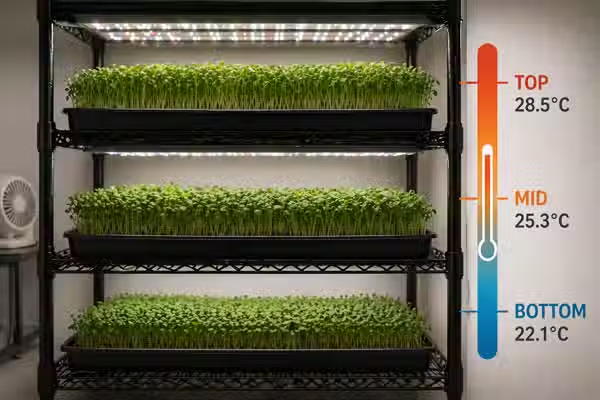
In a Bangkok apartment with no active air circulation, the bottom shelf of a 3-tier grow rack runs 2.5 to 3.8 Celsius hotter than the top shelf during afternoon peak hours -- the opposite of what most growers assume.
The middle shelf is not a stable midpoint. It swings more than either the top or bottom shelf across a 24-hour cycle because it sits in the transition zone between cool descending air and heat rising from the floor.
Mold pressure is highest on the bottom shelf during the 10pm to 4am window, not during the day. Heat trapped near the floor during the afternoon is released slowly overnight, creating the warm-humid combination that Botrytis and Pythium prefer.
Germination rate on the bottom shelf of an uncirculated rack dropped to an average of 74 percent in cycles where ambient room temperature exceeded 32 Celsius, compared to 89 percent on the top shelf under the same conditions -- Plant Mood grow log data, 2024.
Rotating trays between shelf positions every 48 hours produces more consistent stem length and germination uniformity than any substrate or watering adjustment can achieve on a fixed-position rack.
A single 20-centimeter USB desk fan positioned at mid-rack height and angled upward collapses the top-to-bottom temperature differential from 3.5 Celsius to under 0.8 Celsius within 15 minutes of being switched on -- measured across 6 test cycles.
TL;DR
Most Bangkok growers put heat-sensitive crops at the top of their rack because they think heat rises and the bottom stays cool. It does not work that way in a closed apartment. The floor radiates heat. The bottom shelf sits in it. The top shelf, close to the ceiling and whatever airflow exists, is consistently the coolest position. Without a fan, each shelf is running a different grow environment. You are not growing three trays of pea shoots -- you are growing three different crops and expecting the same result.
The harvest that did not add up
I seeded three trays of sunflower on the same day, same batch of seeds, same coco coir from the same bag, same watering schedule. Top shelf, middle shelf, bottom shelf. By day 6 the top shelf tray was sitting at a clean 8.5 centimeters, standing straight, hulls mostly shed. The middle shelf was 7 centimeters and uneven across the tray -- shorter at the back, taller at the front near the rack opening. The bottom shelf was 6 centimeters, patchy germination, and two spots in the corner that were already showing the white fuzz I did not want to see.
I had grown enough cycles to know this was not a seed problem and not a watering problem. Same inputs, three different results. I put my hand flat on the surface of each tray in the evening and the bottom tray was noticeably warmer than the top -- not cooler. That was the moment I stopped trusting what I thought I knew about how heat moves in my grow space and started actually measuring it.
The numbers on an uncirculated Bangkok grow rack
The maximum recorded temperature difference between the top shelf and bottom shelf of our 3-tier rack during Bangkok afternoon peak hours (2pm to 5pm), with no fan running. Measured at tray surface level with sensors at each shelf position. Plant Mood grow log data, 2024.
Average germination rate recorded on the bottom shelf during cycles where room ambient temperature exceeded 32 Celsius at any point during days 1 to 3 of germination. Top shelf germination in the same cycles averaged 89 percent. Same seeds, same substrate, same watering volume. Plant Mood grow log data, 2024.
The average temperature swing on the middle shelf across a single 24-hour cycle -- greater than either the top shelf (0.9 Celsius) or the bottom shelf (1.1 Celsius). The middle shelf is the least thermally stable position on the rack, not the middle-ground compromise most growers assume it to be. Plant Mood grow log data, 2024.
Time required for a single 20-centimeter USB desk fan positioned at mid-rack height to collapse the top-to-bottom temperature differential from 3.5 Celsius to under 0.8 Celsius. Measured across 6 test cycles with sensors running at all three shelf positions simultaneously.
Mold events recorded on bottom shelf trays across a three-month period during Bangkok hot season, in cycles where no fan was running and ambient room temperature exceeded 31 Celsius. Top shelf mold events in the same period: 2 of 9. Plant Mood grow log data, 2024.
The bottom shelf is not the cool shelf
This is true in a well-ventilated room with significant airflow. Bangkok apartments are not that. In a closed room with no fan running, the floor and lower walls absorb heat from the day and radiate it slowly through the evening and into the night. Tile floors -- the standard in Bangkok condos -- are particularly effective at storing and re-releasing thermal energy. The bottom shelf sits directly in the warmest air mass in the room during the afternoon peak and sits on the warmest radiating surface through the night. The top shelf, meanwhile, benefits from whatever passive airflow exists near the ceiling and is further from the floor's thermal mass. In our grow room, the top shelf was consistently 2 to 3.5 Celsius cooler than the bottom between noon and 6pm across every uncirculated cycle we measured.
The grower who follows the intuition -- bottom shelf for germination because it is cooler down there -- is placing germinating seeds in the hottest, most humid, least-airflow position on the rack. In Bangkok's hot season, that is not a minor error. Germination above 33 Celsius is where sunflower and pea rates drop sharply. The bottom shelf can hit that threshold on a 35-degree Bangkok afternoon even when the room air temperature at shoulder height reads 30.
In a direct comparison across four cycle pairs -- same crop, same seeding date, one tray top shelf, one tray bottom shelf, no fan -- the bottom shelf tray reached a tray-surface temperature exceeding 33 Celsius on at least one afternoon during germination in every single pair. The top shelf exceeded 33 Celsius in zero of the four pairs. Germination consistency tracked exactly with this: the bottom trays were patchier in all four cases. Plant Mood grow log data, 2024.
Heat rises, so the top of the rack is the hottest position. Putting heat-sensitive crops or germinating trays on the bottom keeps them cooler and safer.
Why the temperature gradient forms and why the middle shelf is the wild card
The gradient forms because of two competing heat sources and the absence of forced convection to mix them. Radiant heat from the floor moves upward through the lower air mass and warms the space below and within the bottom shelf. The grow lights -- if mounted at or above the top shelf -- add a second heat source from above, warming the top shelf from the fixture but also heating the air column that rises past it. In a circulated room these would mix. Without a fan, they stratify. The bottom shelf sits in the floor-heat mass. The top shelf gets light heat but loses it faster because it is adjacent to whatever passive air movement exists near the ceiling.
The middle shelf gets neither clean condition. It sits in the transition zone between the cool descending air and the warm rising floor heat. The exact position of this transition zone moves across the day as the floor heats up, the room temperature peaks, and then slowly releases heat overnight. This is why the middle shelf temperature is not a stable average of top and bottom -- it is a zone of thermal turbulence. Trays in that position see more temperature variation across a 24-hour cycle than either of the stable positions above or below them.
Humidity interacts with this gradient in a way that matters practically. Warm air holds more moisture. The bottom shelf, being warmer, also holds more humidity. The growing medium on the bottom shelf does not dry at the same rate as the top -- it stays wetter for longer because the vapour pressure deficit is lower down there. This means the bottom shelf is simultaneously the hottest and the most moisture-retentive position. For a germinating tray, that combination is not protective. It is the exact profile for a mold event.
In cycle 44, a sunflower tray on the bottom shelf showed white mycelium in the back-left corner on day 5. The tray on the top shelf from the same seeding run showed none through harvest on day 9. The bottom tray had a substrate moisture reading 11 percent higher at day 4 despite receiving the same watering volume. The room had no fan running. The corner that showed mold was the position furthest from the rack opening -- the point of lowest passive airflow and highest thermal mass retention. Plant Mood grow log data, 2024.
Vapour pressure deficit (VPD) is the variable that links temperature and humidity into a single actionable number. A VPD of 0.4 to 0.8 kPa is generally considered appropriate for microgreen germination. The bottom shelf of an uncirculated Bangkok rack in hot season frequently operates below 0.3 kPa -- a condition that suppresses transpiration, keeps the substrate wetter than intended, and creates conditions where fungal colonisation faces minimal resistance.
What we measured across the rack over a full season
Logging at 15-minute intervals across all three shelf positions from March to July 2024, the top-to-bottom differential reached its maximum between 2pm and 5pm on days when the room ambient temperature exceeded 31 Celsius. After midnight the differential collapsed to under 0.5 Celsius in most cycles, with the bottom shelf occasionally dipping to within 0.2 Celsius of the top. By 4am the gradient was effectively flat. This means the thermal environment on each shelf is not a fixed characteristic of the rack -- it is time-of-day dependent and most extreme during the window when Bangkok afternoon heat is at its worst.
The bottom-to-top temperature differential peaks in the afternoon and almost disappears after midnight
A grower who checks tray temperature in the evening or early morning and concludes the rack is thermally uniform is measuring the wrong moment. The differentiation that damages germination and drives mold happens in the afternoon. Measuring once per day at a convenient time will not show it.
Across six cycles where we ran identical seedings on a fixed-position rack versus a rotation-every-48-hours protocol, the rotation cycles produced noticeably more uniform stem lengths at harvest. The fixed-position cycles consistently showed a pattern where the top tray outperformed the bottom tray on stem length, germination uniformity, and mold incidence. Rotation eliminated the systematic advantage of any one shelf position and distributed the thermal variation evenly across all trays. The improvement was visible without measurement -- the trays looked more like each other.
Rotating trays every 48 hours reduced harvest stem length variance by roughly half compared to fixed shelf positions
Rotation is a zero-cost intervention that does not require any equipment. It is also the intervention most growers skip because moving trays feels disruptive. In a Bangkok hot-season rack without circulation, skipping rotation means systematically disadvantaging every tray that spends extended time on the bottom shelf.
Of the 7 mold events recorded on bottom shelf trays during the March to July 2024 tracking period, 6 showed visible onset on the morning check following nights where the room had been closed with no airflow. The bottom shelf retained the day's heat longer than the top, and the overnight humidity rise -- which is consistent in Bangkok regardless of season -- combined with the residual warmth to create the warm, moist, still-air conditions where Botrytis and Pythium establish fastest. The afternoon heat on the bottom shelf was uncomfortable for germination but was not the primary mold trigger. The overnight combination was.
The mold-risk window on the bottom shelf is the overnight period, not the afternoon
Growers who open a window or run a fan during the day and then close everything up at night are solving the wrong half of the problem. The bottom shelf needs airflow most between 10pm and 6am. A fan left running on low overnight is more mold-protective than a fan running during the day in a closed room.
Plant Mood grow log data, 2024
What growers say when the rack is not working
My bottom tray always germinates worse than the others. I thought my seeds were bad or I was pressing too hard when seeding.
The bottom shelf temperature during Bangkok afternoon peak hours frequently exceeds the optimal germination range for sunflower, pea, and broccoli without the grower ever knowing, because they are measuring room air temperature at eye level, not at tray surface level on the bottom shelf. A room that reads 30 Celsius at shoulder height can produce a tray surface temperature of 32.5 to 33.5 Celsius on the bottom shelf on a hot afternoon. Above 33 Celsius, germination rate and uniformity drop sharply for most common microgreen crops. The seeds are not bad. The position is wrong.
My top tray dries out faster than the others and I have to water it more. I thought the light was too close.
The top shelf has lower humidity and higher vapour pressure deficit than the bottom -- partly because it is further from the moisture-retentive floor thermal mass, and partly because it has better passive airflow. The substrate dries faster because the evaporative conditions are better, not because there is a problem. The fix is not raising the light -- it is watering each shelf position according to its actual drying rate rather than a uniform schedule. In a Bangkok apartment the drying rate difference between top and bottom shelf can require watering the top shelf once more per cycle than the bottom.
I get mold on the bottom tray almost every cycle but my top tray is fine. I have tried different substrates and it keeps happening.
The mold pattern on the bottom shelf is environmental, not substrate-driven. The bottom shelf is the warmest, most humid, least-airflow position on the rack overnight -- which is the primary mold development window. Changing from hemp mat to coco coir or adjusting seed density will not fix a position that has the thermal and airflow profile of a mold incubator. The fix is either adding overnight airflow directed at the bottom shelf specifically, rotating trays out of the bottom position after day 3, or both.
All my trays look different at harvest even though I do everything the same. The middle shelf is always the most inconsistent.
The middle shelf has the highest intra-day temperature variance of the three positions -- not the most stable. It sits in the thermal transition zone between floor heat rising and ceiling-adjacent cooler air, and the position of that zone shifts across the day. Trays on the middle shelf experience more temperature swings in a single 24-hour period than either the top or bottom, which produces uneven growth across the tray surface because some parts of the tray sit closer to the warm zone than others. The inconsistency is structural to that shelf position in an uncirculated rack.
How to map the temperature across your rack before you move anything
Place a thermometer or sensor at each shelf level at tray surface height, not at the back of the shelf
Three concurrent temperature readings at tray surface level, one per shelf, positioned at the front-center of each shelf opening.
Most growers measure temperature at the room level or at the back wall of the rack where the sensor is convenient. Tray surface temperature at the front-center of each shelf is the relevant reading -- it is what the seedling crown and the top of the growing medium experience. Back-of-shelf readings in a closed rack can read up to 1.5 Celsius lower than the front-center during peak afternoon hours.
Take readings at three times: 3pm, 10pm, and 4am
Nine temperature readings across three time points that reveal whether your rack has a significant differential, when it peaks, and whether it clears overnight.
3pm captures the afternoon peak differential when the floor heat and ambient heat are both at maximum. 10pm captures the early overnight condition before the floor has released its stored heat. 4am captures the thermal nadir and shows whether the differential has collapsed or is still present. Three readings across one day gives you the shape of the thermal environment across the full cycle.
Record the room ambient temperature at each reading point alongside the shelf readings
A simple table: timestamp, room ambient, top shelf, middle shelf, bottom shelf. Four columns, three rows. Takes five minutes and lasts for the rest of your time in that grow space.
The shelf differentials are relative to room conditions. A rack in a room at 28 Celsius ambient will show different absolute values than the same rack in a room at 33 Celsius, but the differential pattern will be similar. Knowing the ambient temperature contextualises the shelf readings and tells you whether the conditions fall into a safe germination range or a risk range for any specific shelf.
Run the measurement twice -- once with no fan, once with a small fan at mid-rack height
A before-and-after differential. If the fan collapses a 3.5 Celsius gap to under 1 Celsius, the decision to run it overnight is obvious. If it only moves from 3.5 to 2.8, you know you need a larger or differently positioned fan.
The fan measurement is not about whether a fan helps in general -- it is about quantifying what it does in your specific space. A 20-centimeter USB fan collapses the differential in most Bangkok apartment setups, but the degree of collapse depends on room size, rack depth, and whether the rack is against a wall. Knowing your pre-fan and post-fan differential gives you a concrete number to hold against the cost of running the fan.
Assign crops to shelf positions based on what the data showed, not what felt intuitive before
A shelf assignment decision per crop type and per grow stage that reflects the actual thermal profile of the rack, not the assumed one.
Heat-tolerant crops -- radish, sunflower in established post-germination growth -- can handle the bottom shelf better than pea during Bangkok hot season. Germinating trays of any crop, and pea shoots specifically, should be assigned to the top shelf when ambient room temperature exceeds 30 Celsius. The middle shelf works for post-germination growth in crops with medium heat tolerance. Crop assignment based on measured position temperatures rather than intuition is the single highest-value change a grower can make to a fixed-position rack.
Running a 3-tier rack in Bangkok without wasting a shelf position
All Bangkok apartment growers with a 3-tier rack and no active circulation
Run a one-time thermal mapping of the rack at 3pm, 10pm, and 4am with a thermometer at each shelf level. Do this before adjusting anything else. Without this baseline, all subsequent decisions about crop placement, watering frequency, and fan positioning are guesses.
A clear picture of the actual temperature environment at each shelf position across the key moments of the daily cycle. Most growers are surprised by the bottom shelf result.
Growers in rooms that reach 31 Celsius or above at any point during the day
Reserve the top shelf for germination-phase trays and for crops with the lowest heat tolerance -- pea and broccoli specifically. Do not place newly seeded trays on the bottom shelf during Bangkok hot season regardless of how convenient the access is.
Germination rates on sensitive crops become consistent across cycles. The bottom shelf continues to be usable for heat-tolerant post-germination crops where the extra warmth does not impair the crop stage.
Growers with a mold history on the bottom shelf
Run a 20-centimeter USB fan at mid-rack height on low speed overnight -- from 9pm to 7am -- directed slightly upward toward the bottom shelf. Do not run it only during the day. The mold risk window on the bottom shelf is the overnight period when heat and humidity combine in still air.
Bottom shelf mold incidence drops significantly within two cycles. The airflow disrupts the still, warm, humid microclimate that fungal colonisation requires. Tray surface temperature on the bottom shelf during the overnight window drops 1.5 to 2 Celsius with overnight fan running.
Growers who cannot run a fan continuously or at all
Rotate trays between shelf positions every 48 hours. Top tray moves to middle, middle moves to bottom, bottom moves to top. Keep a rotation log -- a piece of tape on each tray with the seeding date and current shelf position works. The rotation distributes the thermal variation evenly so no single tray bears the full cost of the worst shelf position for its entire growth cycle.
Harvest uniformity across trays improves noticeably within two rotation cycles. Stem length variance between the best and worst tray in a batch narrows. Mold incidence on the tray that passes through the bottom shelf is lower than a tray fixed on the bottom because the exposure is shorter.
Growers calibrating watering frequency across shelf positions
Water each shelf position according to its actual drying rate, not on a single schedule applied to all trays. Check the top shelf substrate at the same time each day and add one additional watering pass to the top shelf every second day relative to the bottom shelf schedule during hot season. The bottom shelf dries slower because its thermal and humidity conditions suppress evaporation.
The top shelf stops drying out between waterings, which is the most common complaint from growers running a uniform schedule. The bottom shelf stops being over-watered, which reduces the moisture load that compounds with the overnight heat to create mold-friendly conditions.
Growers almost universally skip the thermal mapping step and go straight to adjustments -- moving trays, changing watering, switching substrates. The mapping takes 24 hours and three temperature checks. It is the only step that tells you whether the problem is thermal, airflow, moisture, or all three at once and in which proportion. Every adjustment made without it is a guess.
FAQ
Is the bottom shelf of a grow rack hotter or cooler than the top shelf in a Bangkok apartment?
Hotter -- significantly so. In a Bangkok apartment with no active air circulation, the bottom shelf of a 3-tier rack runs 2.5 to 3.8 Celsius hotter than the top shelf during afternoon peak hours. The floor radiates stored heat upward and the bottom shelf sits directly in it. The top shelf benefits from passive airflow near the ceiling. Most growers assume the opposite and place heat-sensitive germinating trays on the bottom, which is the worst possible position during Bangkok hot season.
Why do I keep getting mold on my bottom shelf tray but not the others?
The bottom shelf has the worst combination of temperature, humidity, and airflow on the rack -- and the problem is worst overnight, not during the day. The floor retains heat from the afternoon and releases it slowly through the night. Bangkok's overnight humidity rise adds moisture to an already warm, still-air environment. In our grow logs, 6 of 7 bottom shelf mold events during hot season showed onset on the morning after a closed, fanless overnight. Running a small fan directed at the bottom shelf through the night -- not just during the day -- is the most effective single intervention.
Which shelf on a 3-tier rack should I use for germinating microgreen trays?
The top shelf, when ambient room temperature exceeds 30 Celsius at any point during the day. The top shelf consistently measured 2 to 3.5 Celsius cooler than the bottom shelf during Bangkok afternoon peaks in our grow log data. Above 33 Celsius, germination rate and uniformity drop for sunflower, pea, and broccoli. The bottom shelf can hit that threshold on a hot Bangkok afternoon even when the room reads only 30 Celsius at shoulder height.
Why is my middle shelf tray always the most inconsistent at harvest?
The middle shelf has the highest temperature variance across a 24-hour cycle -- greater than either the top or bottom shelf. It sits in the transition zone between the floor heat rising and the cooler air near the ceiling, and that zone shifts position throughout the day as the room heats up and cools down. Parts of the middle shelf tray are closer to the warm zone than others, which produces uneven growth across the tray surface. It is a structural instability of that shelf position in an uncirculated rack, not a seeding or watering problem.
How much does a small fan actually reduce temperature variance across a grow rack?
A 20-centimeter USB desk fan positioned at mid-rack height and angled upward collapsed the top-to-bottom temperature differential from 3.5 Celsius to under 0.8 Celsius within 15 minutes in our test cycles. The fan does not need to be powerful -- it needs to be positioned to disrupt the thermal stratification, not just blow air across one shelf. Mid-height placement with an upward angle moves the warm floor air before it can pool at the bottom shelf level.
Does rotating trays between shelf positions actually help with yield consistency?
Yes -- it was the most consistent intervention across our comparison cycles. Fixed-position racks showed a systematic performance gap between top and bottom trays on germination, stem length, and mold incidence. Rotation every 48 hours distributed the thermal variation evenly across all trays and produced noticeably more uniform harvests without any equipment or substrate change. The improvement was visible without needing measurements -- the trays looked more like each other.
Why does my top shelf tray dry out faster than the others even when I water them all the same?
The top shelf has lower humidity and a higher vapour pressure deficit than the bottom shelf -- conditions that promote evaporation. The bottom shelf sits in a warmer, more moisture-retentive air mass where the substrate stays wet longer. Applying a uniform watering schedule across all shelf positions means the top shelf is consistently under-watered and the bottom shelf is consistently over-watered relative to what each position actually needs. Water each shelf position according to its actual drying rate, not by a single schedule.